Factors to Consider When Choosing an Industrial Adhesive
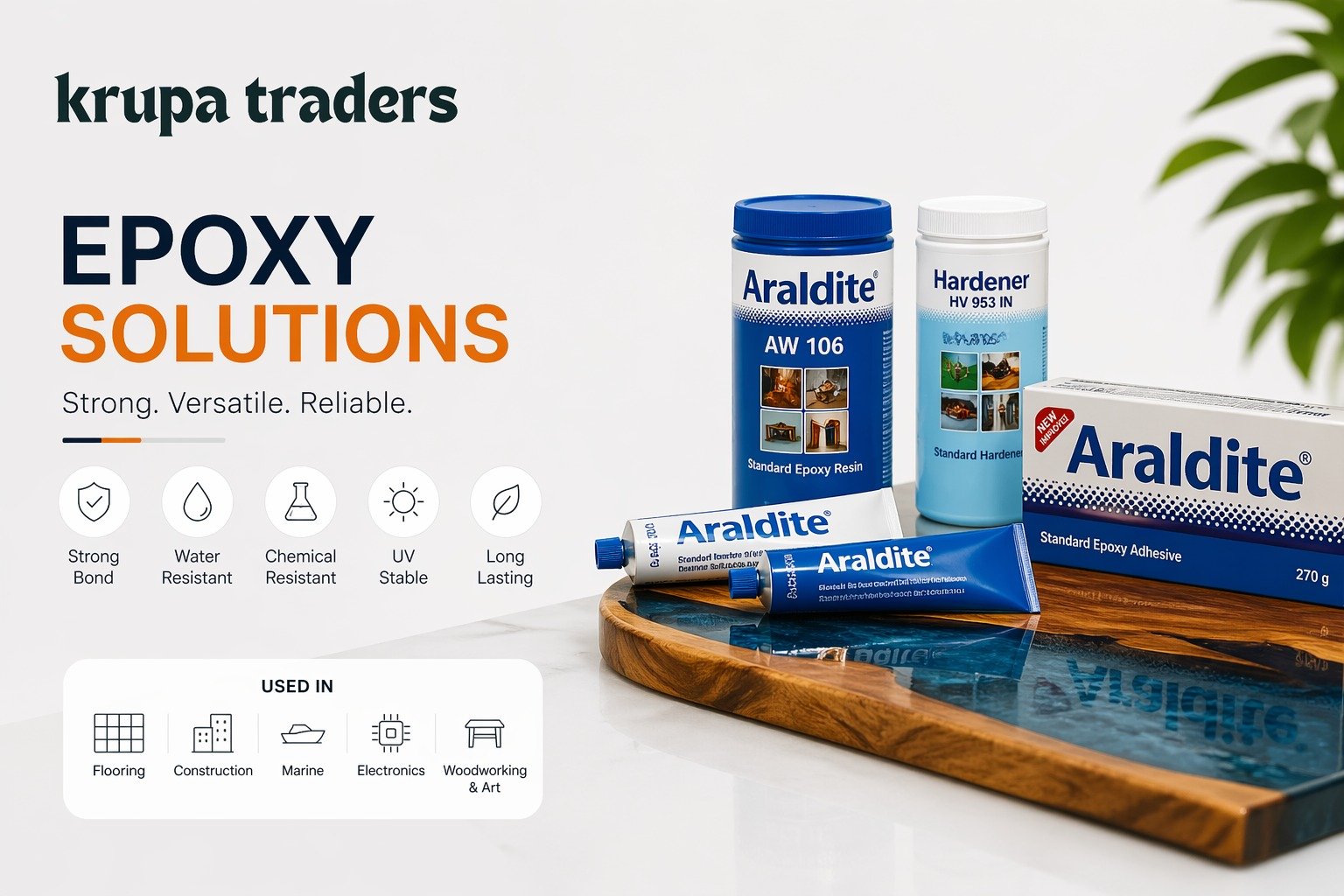
Walk into any fabrication shop or construction site and you'll usually find at least three or four different adhesives lying around, and half the time nobody remembers exactly why each one was picked. That's a problem, because industrial adhesives aren't interchangeable the way people sometimes assume. The wrong choice doesn't just mean a weaker bond — it can mean a joint that fails months later under heat, moisture, or vibration that the adhesive was never built to handle. At Krupa Traders, we've spent over three decades supplying Araldite and BOSS products across Gujarat and the rest of India, and the same handful of questions come up again and again when someone's trying to pick the right one. Here's a straightforward answer to each.
What Materials Are You Actually Bonding?
This is the first question that should get asked, and it's surprising how often it gets skipped. Metal-to-metal bonding usually calls for a structural epoxy like Araldite Standard or Araldite Klad X, which cures into a rigid, high-strength joint. Plastics, especially low-surface-energy ones, need an adhesive formulated to grip smooth, non-porous surfaces — plain epoxy won't hold on certain plastics no matter how well it's applied. Glass and ceramics often do better with a clear epoxy like Araldite Klear, since strength and finish both matter. If you're bonding dissimilar materials, say metal to rubber or wood to plastic, the adhesive needs enough flexibility to absorb the different expansion rates of each material, which usually points toward a hybrid polymer or PU-based product rather than a rigid epoxy.
How Much Flexibility Does the Joint Need?
A rigid epoxy bond is excellent for load-bearing joints that won't move, but it's the wrong choice for anything that flexes, vibrates, or experiences thermal expansion — think window frames, expansion joints, or automotive panels. In those situations, hybrid polymer sealants and PU sealants outperform epoxies because they stay elastic after curing, moving with the substrate instead of cracking. BOSS hybrid polymer sealants are commonly used for exactly this reason on construction joints and panel installations where some degree of movement is expected over the structure's life.
What Environment Will the Bond Be Exposed To?
Temperature swings, moisture, UV exposure, and chemical contact all affect how long an adhesive lasts. An adhesive that performs perfectly indoors can degrade quickly outdoors if it isn't UV-stable, and a bond that holds in dry conditions can fail once water gets into the joint. For outdoor or wet-area applications, silicone sealants and neutral RTV silicones handle moisture and weathering far better than standard epoxies. For areas exposed to industrial chemicals or fuels, it's worth checking the resistance rating specifically, since general-purpose adhesives aren't built to handle solvent exposure over time.
How Fast Do You Need the Bond to Cure?
Cure time affects both your workflow and the final bond strength, and faster usually isn't better. Fast-setting formulas like Araldite Klear 4 Plus are useful for quick repairs or when a production line can't afford long downtime, but they typically reach full strength faster at the cost of slightly lower peak strength compared to slower-curing structural epoxies. For load-bearing or safety-critical joints, it's usually worth the extra curing time rather than rushing the job with a fast-set adhesive that isn't rated for the load.
Is the Surface Prepared Correctly?
This one has nothing to do with which product you buy and everything to do with how well it performs. Oil, dust, rust, or old sealant residue on a surface will weaken any adhesive bond, no matter how good the formula is. Gasket makers and sealants in particular need a clean, dry surface to form a proper seal — skipping this step is probably the single biggest reason industrial bonds fail prematurely, more so than picking the wrong product.
Application Method and Job Size
For small jobs and repairs, tube or cartridge-based products with a gun applicator work fine. For larger production runs or bulk industrial use, it makes more sense to source larger packaging and, where needed, dispensing equipment suited to the volume. This is also where working with a stocking distributor rather than a single retailer helps — bulk pricing and consistent supply matter once you're using adhesives and sealants as part of a regular production process rather than the odd repair job.
A Quick Way to Narrow It Down
If you're still unsure, a simple rule of thumb helps: rigid, high-load, metal-to-metal joints usually call for an epoxy like Araldite; joints exposed to movement, weather, or moisture usually call for a silicone or hybrid polymer sealant like BOSS; and quick fixes or small bonds on plastic or rubber often just need a cyanoacrylate super glue. Getting this broad category right solves most of the decision before you even get into specific product grades.
Get the Right Adhesive the First Time
Choosing between epoxy, silicone, PU, and hybrid polymer products isn't something you have to figure out alone. Krupa Traders has been supplying genuine Araldite, BOSS, and WD-40 products across India for over 30 years, and our team can help match the right adhesive or sealant to your specific material, environment, and application before you place an order. Reach out to us for product recommendations, bulk pricing, or technical guidance on your next project.
Need Help Choosing the Right Adhesive?
Browse our range of Araldite, BOSS & WD-40 products at
krupatraders.com
© Krupa Traders | krupatraders.com | Industrial Adhesive & Sealant Specialists India